Content Menu
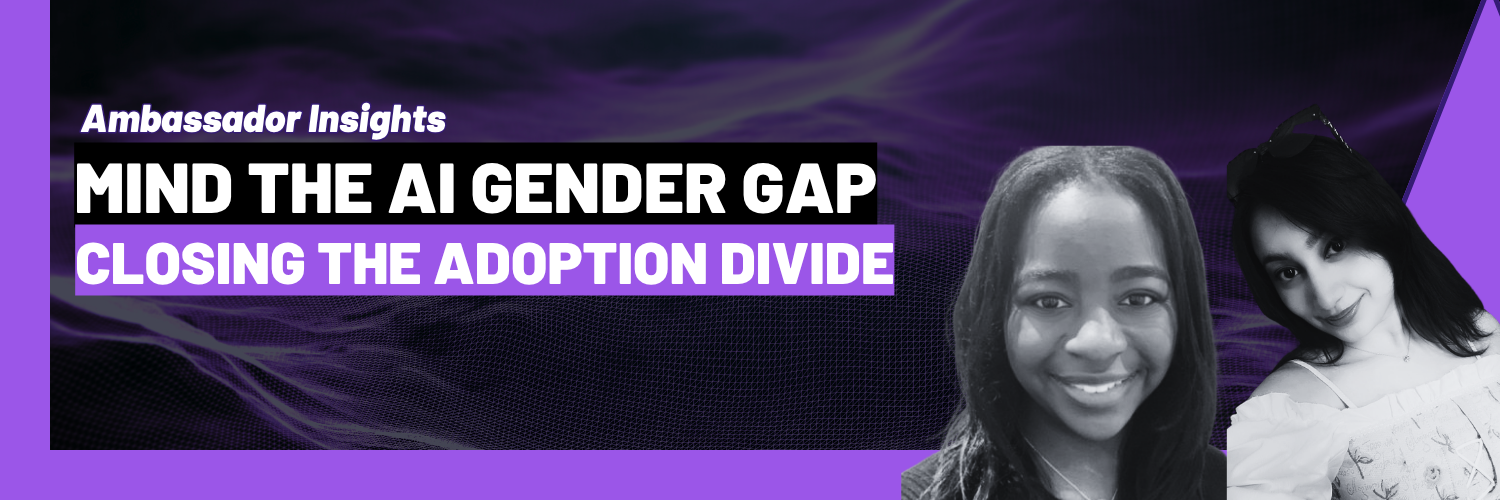
MIND THE AI GENDER GAP: CLOSING THE ADOPTION DIVIDE IN TECH
Research shows that there is an AI adoption gap in tech, with women adopting AI tools at a significantly lower rate than men. But why?
Code First Girls Ambassadors Rochelle Ayad (AI Engineer) and Hitaeshi Sehgal (AI Researcher) break down what’s really going on. They share why women hold back at work, how to back yourself, and what companies must do to help.
Let’s dive in!
Insights from Rochelle: Navigating the AI gender gap
As a newly pivoted AI Engineer, reflecting from my past personal experiences, I used to see a lot of women hesitant to use artificial intelligence. We either strive ahead, eager to adopt new tools, or hold back out of fear of being left behind. On both ends, women are trying to use AI intentionally while dodging unfair labels such as being called “lazy” with code or simply not being an “efficient enough” engineer. In a heavily male-dominated sector where women already feel the pressure to work twice as hard to earn promotions, that hesitation is completely valid.
During my first tech role as a Junior Software Engineer at a fintech, I saw this AI adoption gap firsthand within my team and among friends. Male colleagues openly discussed leveraging AI tools to accelerate their outputs. Meanwhile, my female peers and I would hesitate, worried about extra scrutiny or feeling bound by advice that juniors/mid-levels should avoid AI and stick strictly to the foundations.
AI is a tool, not a shortcut
It is time to dismantle these misconceptions and reframe from that narrative. AI is an incredible tool to enhance our work, not a crutch or a shortcut to write everything. Alternatively, we must also acknowledge the downsides of using AI such as environmental impacts, lack of motivation, or the risk of “brain rot”. Consequently, avoiding AI altogether will only hold us back, reinforce the AI adoption gap and stop us from reaching our full productive potential.
3 ways women in tech can bridge the AI adoption gap
The best way to overcome this invisible barrier is to dive right in and take proactive ownership over your professional growth:
- Claim your learning time: Don’t wait around for permission. Demand structured learn-time for Generative AI/LLM training, attend industry conferences, build your network, and earn certifications.
- Drive the conversation: Initiate open discussions with your line manager to set clear expectations around modern AI tool adoptions. It can be tough, but so are you!
- Bet on yourself: Growth can happen anytime. I spent time upskilling after work focusing on my AWS Cloud Practitioner certification, building personal projects, and completing pathways on DataCamp. Overall, putting my own development first gave me the confidence to fully transition into the Data & AI sector, and I couldn’t be happier and feel more embraced in my new role.
Lean into feeling comfortable with the uncomfortable because the industry will always shift. Stay curious and keep tinkering with new tools. AI won’t replace adaptable engineers; it will elevate them. You hold the power to shape your own career.
Insights from Hitaeshi: How organisations can solve the AI adoption gap
Reading your experience made me think about something that often gets overlooked in conversations about AI and AI adoption gap. We usually talk about encouraging individuals to learn new tools, be more confident, or become more adaptable. While that’s important, I don’t think the responsibility should rest entirely on individuals. Organisations have an equally important role to play in creating environments where people feel safe enough to learn in the first place.
Nobody has it all figured out
One of the biggest misconceptions about AI is that everyone has already figured it out. From the outside, it can seem as though everyone else knows exactly which tools to use, how to write the perfect prompt, or how to integrate AI into their daily work. The reality is often very different. Many people are quietly experimenting behind the scenes, wondering if they’re using the tool correctly, whether they’re relying on it too much, or even if they’ll be judged for using it at all.
Those feelings become even stronger when there isn’t a culture that encourages curiosity. If people feel they have to already be experts before asking questions, many simply won’t ask. They’ll avoid experimenting altogether because nobody wants to be the person who admits they don’t know where to begin.
How organisations can close the gender gap in AI adoption
That’s why organisations have such an important opportunity to shape how AI is introduced. Instead of expecting employees to figure everything out on their own, organisations can normalise learning by offering practical workshops, creating spaces where people can openly share tips and experiences, and encouraging leaders to talk honestly about how they use AI in their own work.
Small actions make a big difference. A shared prompt library, regular AI learning sessions, internal communities where people can ask questions without judgement, or celebrating experimentation instead of perfection can help remove the fear that surrounds new technology.
AI is your partner, not your replacement
It’s also important to change the conversation around what AI is for. AI shouldn’t be introduced as a shortcut or a replacement for people’s skills. Instead, it should be seen as a partner that helps people focus on creativity, critical thinking, empathy, and problem-solving. Whether helping someone organize research, summarize notes, brainstorm ideas, or overcome writer’s block, AI works best when it enhances human capability rather than replacing it.
Most importantly, organisations need to remember that confidence grows through experience. It grows when people are supported when they make mistakes and recognised for their willingness to learn rather than judged for not knowing everything immediately. When organisations invest in that kind of environment, they don’t just build better AI users; they build more confident, innovative, and empowered teams.
Ready to bridge the AI adoption gap? We’ve got you covered.
- Starting your AI journey? Build your foundation with our free, self-paced Tech Tasters courses (mixed genders).
- Ready to level up in tech? Upskill fast with our dedicated 4-week AI & ML +Masters course (women and non-binary only, open by application only).
- Empowering your team? Discover our tailored employee training programmes (mixed genders and sponsorship by your employee only).