Content Menu
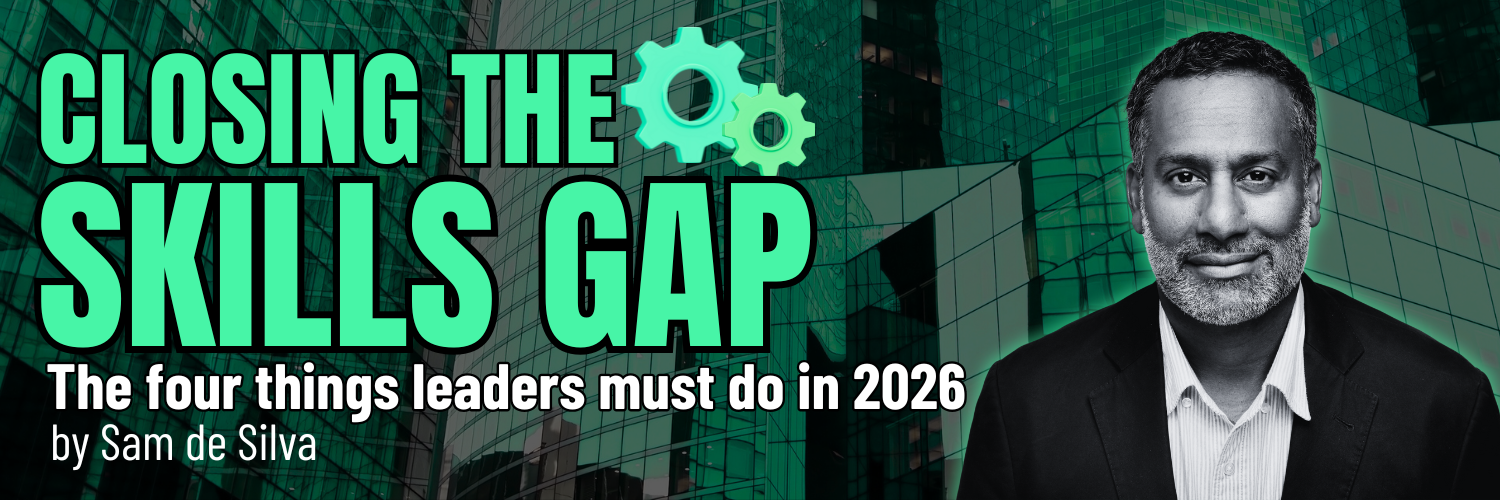
THE AI DIGITAL SKILLS GAP IS GROWING: HERE'S WHAT LEADERS NEED TO DO DIFFERENTLY IN 2026
Sam de Silva is an independent AI Strategy Advisor and Consultant, specialising in helping organisations implement AI responsibly and build AI literacy across their workforce. Sam is also on the Tech Advisory Board of Code First Girls.
The AI digital skills gap is widening faster than expected
The start of a new year often brings reflection on personal goals and achievements: what progress was made, what skills improved, and where focused training made the biggest difference. That same mindset of deliberate goal-setting and sustained effort is increasingly relevant for organisations navigating rapid technological change.
As we enter 2026, the digital skills gap is no longer a future risk; it is a present-day constraint on growth, resilience, and competitiveness. Generative AI has been adopted at unprecedented speed, and expectations for agentic AI and automation continue to rise. Yet many organisations are finding that their workforce is struggling to adapt at the same pace.
Removing the risk of a two-tiered workforce
This gap is no longer primarily technical. It is strategic. The challenge is not simply access to AI tools or training, but whether organisations have a coherent approach to building capability across roles, functions, and geographies. In many cases, AI initiatives are advancing faster than the workforce’s ability to understand, apply, and govern them effectively.
Boards and executive teams are rightly focused on return on investment from AI programmes. But without widespread AI literacy and clear learning pathways, innovation becomes concentrated in small teams, while others are left without the opportunity to participate.
Left unaddressed, this divide risks slowing transformation, eroding trust in AI, creating a two-tiered workforce, and making it increasingly difficult to attract and retain talent.
Understanding what is driving this gap and how leaders must respond differently in 2026 is now a critical priority.
Understanding what's driving the AI digital skills gap across organisations
The following factors help explain why the AI digital skills gap continues to widen and provide key review points for leadership teams.
Different roles across the AI workforce
AI now touches many distinct groups. First are users, who rely on AI for personal productivity and decision support. Second are no-code and low-code makers, who automate simple workflows using AI agents without traditional software development skills. Third are developers, who design, build, integrate, and scale complex AI solutions within enterprise systems. Additionally, there are groups focused on security, compliance, and governance, all of whom require continuous training.
Gaps in learning journeys and progression paths
Without defined learning pathways for each group, employees struggle to build confidence or progress. The absence of crossover routes from user to maker, or maker to developer, limits internal mobility, slows capability growth, and increases attrition. Some demographics within the organisation will require specific support and training programmes. One learning model may not suit everyone, as people learn in different ways.
Skills challenges in legacy technology transitions
Many organisations still rely on legacy systems alongside modern cloud and AI platforms. Maintaining both requires different skill sets, yet few organisations have a clear transition strategy that covers both the legacy technology and the people who currently support it.
Untapped potential of no-code and low-code makers
No-code and low-code platforms are enabling non-engineers to build automation and AI-enabled workflows. However, learning strategies often remain focused on technical teams, leaving a growing group of potential makers unsupported. This is possibly the most untapped group, who have business knowledge and who are closer to understanding exactly what workflows need to be automated and what a successful output looks like to create business value. These are citizen developers, and this is how organisations scale and democratise AI.
Data and cyber capability lag
AI initiatives depend on strong data foundations and cyber resilience. When data engineering, governance, and security skills lag behind experimentation, operational and regulatory risks increase.
Lack of a continuous learning culture
Training is still too often treated as a one-off intervention rather than a sustained journey. Without enablement, safe environments, and continuous learning embedded into day-to-day work, skills quickly become outdated.
Together, these factors explain why the gap continues to widen and why addressing it now requires a fundamentally different strategy.
How the workforce is changing: emerging trends
Several trends are reshaping how organisations build and deploy capability. AI agents are moving from experimentation to production, automating tasks such as data analysis, content generation, and workflow orchestration.
At the same time, the rise of citizen developers and makers is expanding who can build with technology, enabled by no-code and low-code platforms.
Organisations are increasingly relying on vendors and platforms to deliver AI capability, shifting internal roles towards integration, oversight, and governance.
Together, these trends demand new skills across design, evaluation, and risk management, not just traditional software development.
What to prioritise in 2026: Four key outputs for leaders
1. Build capability at scale - not just tools
Leaders must move beyond tool adoption and focus on capability at scale. This starts with mapping and building AI literacy across all roles, not just technical teams.
Helping employees understand the link between their role function and the capability to create business value through AI is essential. Employees must also be empowered with safe guardrails, clear standards, and feel supported with experimentation.
Data and cloud foundations need modernising to support reliable AI outcomes, and responsible AI governance must be embedded early to manage risk, bias, and compliance.
2. Create clear learning pathways linked to job functions
Organisations must prepare people for redesigned roles through clear learning pathways, recognising that AI will change how work is done, not simply automate it.
HR, Technology and Business leaders must agree on a training strategy aligned with their AI and business strategy, partner with training providers such as Code First Girls/Code First Teams, share real use cases, and select courses that suit different learning needs and organisational cultures.
Educating employees on how their job functions can be linked to AI-enabled business value use cases also creates a value-driven mindset across the organisation and helps employees focus on efficiencies, cost savings and optimising outputs.
3. Actively support at-risk groups through the AI transition
Organisations must consider their entire workforce and identify where groups may be at risk of being left behind. Understanding these groups and their needs helps ensure everyone is engaged, enabled and empowered to contribute to an AI-powered workforce.
This means creating a learning culture that is inclusive, supports different learning speeds and backgrounds, and values both technical capability and the business and cognitive skills required to ensure AI meets human expectations.
4. Draw on multiple training capabilities and models
Closing the digital skills gap requires a capability strategy that draws on multiple pathways, rather than relying on a single type of training or funding model.
Leaders should combine commercially funded programmes with government or grant-supported schemes, such as the UK apprenticeship levy, to build capability at scale across different roles and career stages. AI-driven organisations require a broader mix of skills, not just STEM capability.
The organisations that win will be the ones that adapt and learn fastest
Skills are now a competitive differentiator. In 2026, organisations that succeed will be those that treat learning as a strategic capability, not a support function. AI will reward adaptability, experimentation, and cultural readiness, while exposing gaps in skills, governance, and trust.
Closing the AI digital skills gap is not about training everyone to code. It is about giving people the confidence, pathways, and support to work effectively alongside AI, in a capacity that is appropriate for each employee. Organisations that invest now in a culture of continuous learning and enablement will be better positioned to scale innovation, attract and retain talent, and build resilient, future-ready workforces.