Content Menu
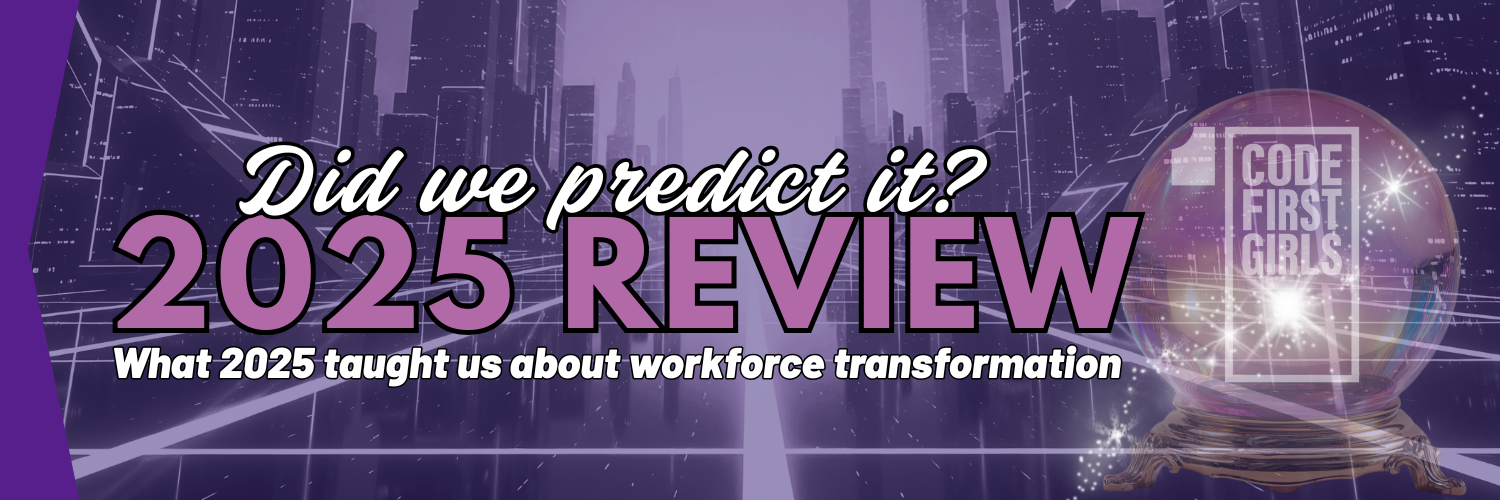
WHAT 2025 TAUGHT US ABOUT WORKFORCE TRANSFORMATION
The crystal ball review
The business world is evolving at breakneck speed – and 2025 was no exception.
This time last year, we dared to predict the hottest and biggest workforce transformation in 2025. A year on, it’s time to reflect: did 2025 pan out as we expected?
And more importantly: what should businesses be thinking about as they head into the new year?
Smart threats, stronger defences
We predicted that as digital transformation advanced, the sophistication of cyber threats would inevitably rise, requiring the development of stronger and more advanced defence mechanisms.
And boy, did 2025 deliver. The BBC reported that the AI platform Claude acted as a ‘criminal co-pilot,’ orchestrating several attacks against over 30 organisations. Retail giant, Marks and Spencer, made headlines after a ransomware attack cost them £300m in lost profits, while Jaguar Landrover suffered from what many dubbed the UK’s biggest ever cyber attack – seeing the car manufacturing industry fall by almost 30% in September. Co-Op were also hit hard, losing £200m in sales after hackers infiltrated the retailer’s IT networks. Meanwhile, AI-powered defence tools leapt forward, with Agentic AI systems (more on this later!) hunting, detecting and managing threats in real-time.
Businesses can’t afford to sit back. To address this growing need, we launched a new Cyber Essentials course to give employees advanced, career-ready skills. We also hosted a major event at the House of Lords with over 100 CISOs, GCHQ, and government Ministers to discuss the evolving threat landscape and the vital role of skills in national defence strategy.
The bottom line: cyber resilience is still mission-critical.
Generative ai as a workforce transformation game-changer
We predicted that Generative AI tools like Gemini and ChatGPT would become embedded in daily work – and we weren’t wrong.
But the real shift was the emergence of Agentic AI – autonomous agents that can plan and execute entire, multi-step workflows (see previous blog for more information). This breakthrough addresses the “GenAI Paradox” (high adoption, low material impact) by moving beyond content generation to automating complex processes – from finance operations to cyber threat detection.
And with Gartner predicting that by 2028, one-third of enterprise software applications will include Agentic AI, it’s clear it is here to stay. To meet this urgent skills demand, we launched our 12-week Agentic AI Tech Accelerator course for mid-level technologists.
The bottom line: GenAI was big but Agentic AI was the breakout star.
AI recruitment tools would support DE&I
We anticipated the use of digital tools, such as AI-driven recruitment and flexible work arrangements, would promote diversity, equity and inclusion (DE&I) by reducing bias and supporting diverse talent. 2025 revealed a more complicated reality.
Take the recent “Bro Boost” LinkedIn experiment which exposed how profile changes – like changing gender to “male” or using “bro-coded” jargon – could boost visibility, suggesting gendered bias in the algorithmic ranking. In the US, hiring software HireVue came under fire when its speech recognition system was found to discriminate against Indigenous, Deaf candidates. And Workday, a global HR and financial cloud software provider, now faces a nationwide collective-action lawsuit. Its AI recruitment tool was found to discriminate against applicants over 40 and on the basis of race and disability.
Regulators are paying attention. A report from the UK Information Commissioner’s Office (ICO) warned that AI-powered recruitment software has inherent risks around data protection and accuracy. As a result, the need for a diverse pool of technologists – and an inclusive AI development approach- is vital.
The bottom line: AI can reinforce inequalities if not designed inclusively and with governance guardrails.
Sustainability tools in the spotlight
We predicted that sustainability would become a central strategic priority for workforce transformation, helping businesses cut waste and optimise energy use. The reality was mixed.
Economic downturn contributed to the rise of “performance-driven ESG,” with investment in green technology only when bottom-line impact is demonstrated. At the same time, some organisations embraced “greenhushing”, scaling back public statements due to rising anti-ESG sentiment.
And while COP25 reinforced the global push for a ‘just transition’ and spotlighted the role of skills in reaching climate goals, the data tells a more nuanced story. The 2025 Green Skills UK Report showed that the average annual growth in green hires (7.8%) continues to outpace the number of professionals gaining green skills (3.4%). The need for businesses to proactively invest in green, digital skills has never been more important.
That is why, as part of the 18 new courses introduced through our foundational Tech Tasters course, we added a dedicated module on sustainable tech – helping more emerging talent build awareness and capability in this critical area.
The bottom line: the sustainability spotlight is not as strong as predicted – yet the need for green skills is urgent.
Was 2025 unprecedented and what does the future hold?
So that begs the question: was 2025 unprecedented for workforce transformation?
We would argue yes.
The sheer speed of change, particularly the rapid pivot from GenAI to Agentic AI, outpaced even our expectations. Meanwhile, AI’s role in sustainability and DE&I continues to grow, but not without raising new questions around ethics, equity, and long-term priorities.
The organisations that will win in 2026 are those investing in workforce readiness today – embedding AI fluency, cyber security resilience, and sustainability skills across their teams to keep pace.
Want to hear more from us (aka Mystic Meg)? Stay tuned for our 2026 forecast!
Can we help with your workforce planning in 2026?
Our mission remains the same: to open up opportunities for women and underrepresented groups while helping organisations build inclusive, future-ready technical teams. Our course and curriculum updates are designed to help employers adapt quickly, upskill effectively, and prepare for what’s next.